

Visit our Location
28936 Old Town Front St.
Suite 106 Temecula, CA 92590

Give us a Call
(951)223-5587


Send us a Message
hello@thetaprootchiro.com



What to Expect at Taproot Chiropractic
Your Complete Journey from First Call to First Adjustment


No Surprises. No Pressure. Just Clear Answers About Your Family's Path to Better Health.
We believe you deserve to know exactly what will happen—from your first phone call to watching your child's nervous system blossom. Here's your complete roadmap.

The Taproot Difference: Why Our Process is Unique
Most practices talk about your child's struggles right in front of them.
We don't.
We understand that labels stick. That pointing out "problems" in front of your child can make them feel broken, different, or like there's something wrong with them.
That's why, for pediatric cases, we conduct the health history consultation over the phone—privately, parent-to-parent. We need to hear the full story, understand the frustrating behaviors and struggles, and gather the complete picture without making your child feel like they're the problem.
Because here's what we know: There are no "bad kids." All behaviors have a purpose.
Your child isn't broken. Their nervous system might just need support to process and engage with the world more efficiently. And we're going to figure that out together—with compassion, without labels, and with your child's dignity intact every step of the way.

Step 1: The Initial Phone Call

What Happens: This isn't a sales call—it's a qualification call to make sure we're the right fit for your family.
We'll:
Listen to your chief concerns and goals
Answer your initial questions about our approach and investment
Determine honestly if we can help (if not, we'll point you in a better direction)
Schedule your next steps if we're aligned
For Pediatric Cases: We'll schedule a separate phone consultation (Step 2) to discuss your child's health history privately.
For Adult/Prenatal Cases: We'll send paperwork and schedule your in-person initial consultation.
Call us: (951)223-5587 or Schedule Online Here

Step 2: Health History Consultation
Before This Call/Visit: You'll complete comprehensive intake paperwork and health history forms (sent digitally after Step 1).
FOR PEDIATRIC CASES — OVER THE PHONE
Why Over the Phone? Your child deserves to be seen as whole and brilliant—not defined by their struggles. We talk privately, parent-to-parent, so you can share the complete story without filters or judgment.
What We'll Cover:
Pregnancy, birth history, and early development
Current challenges (sleep, behavior, focus, emotions, learning)
Developmental milestones and patterns you've noticed
Previous interventions and what you've already tried
Your goals with care
After This Call: We'll schedule your child's in-person examination (Step 3).
FOR ADULTS & PRENATAL — IN PERSON
What Happens: You'll sit down with Dr. Jennifer in a private consultation room to:
Review your health history in detail
Discuss your current concerns, health goals, and daily life patterns
Talk about what you've already tried
Answer all your questions about neurologically-focused chiropractic care
After This Consultation: We move directly into your comprehensive examination (Step 3).

Step 3: The Comprehensive Functional Brain-Based Examination

This is where science meets story. You've told us what you're experiencing. Now we measure what's actually happening in your nervous system.
Our exam is designed to answer the TWO BIG QUESTIONS:
PART 1: Can Chiropractic Help?
Question 1: Are there indicators of stress on the nervous system? Is there movement alteration, postural distortion, or neurological compromise affecting how your brain and body communicate?
What We Assess:
Movement & Postural Analysis — How does your body organize itself in space?
INSiGHT Neurological Scans — Objective measures of nervous system function:
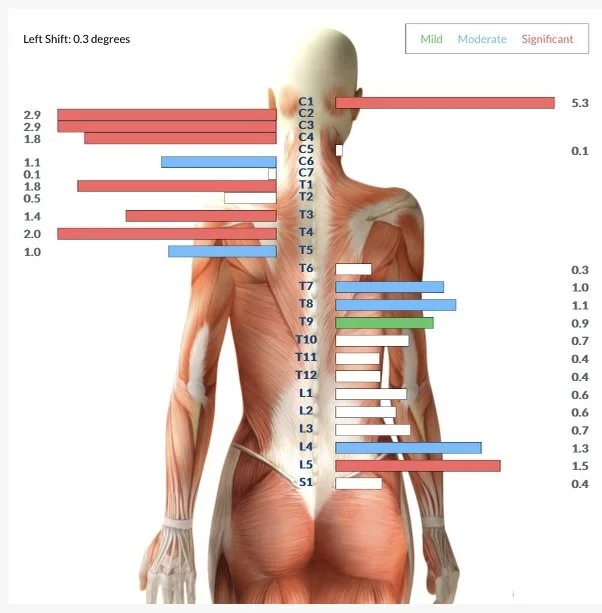
Thermal Scan — Nerve stress and inflammation along the spine
Surface EMG — Electrical activity in muscles controlled by spinal nerves
Heart Rate Variability (HRV) — How well your body handles and recovers from stress
Why This Matters: These scans are completely non-invasive and painless. They give us objective data to determine if chiropractic care can help and create precise care plans.
PART 2: What Tools Are Being Used?
Question 2: What primary tools are being used to process and engage with the world? Can we identify gaps or challenges that may hinder development, engagement, and efficient learning?
What We Examine:
Primitive Reflexes — Foundational neurological patterns that should integrate as we develop
Gross Motor Movements — Large body coordination and balance
Fine Motor Skills — Hand-eye coordination and precision movements
Auditory/Verbal Processing — How sound and language are processed
Eye Movements — Tracking, focusing, and visual coordination
Visual Cognition — How visual information is processed and understood
Why This Matters: Understanding which developmental tools are being used (and which may be missing or inefficient) helps us see the complete picture of how your child—or you—are navigating the world, and tells us how to better support you or your child.

Step 4: Report of Findings
This is where everything comes together.
You've shared your story. We've gathered the data. Now we connect the dots.
Part 1: Scan Review & Education Dr. Jennifer walks through your (or your child's) examination findings, showing you:
Where nerve interference is showing up
What this means for your symptoms
Severity and priority areas
Comparison to optimal function
We answer the Two Big Questions:
Are there inefficiencies in how the nervous system is receiving, processing, and sending information?
What tools is your body using to process and engage with the world—and are they the most efficient?
Part 2: Your Personalized Care Plan Based on your scans, exam, and goals, we'll recommend:
Frequency and duration of care
Re-evaluation schedule to track progress
Home support recommendations (if applicable)
Part 3: Questions, Investment & Next Steps
Any questions about the process or care plan
Financial investment and payment options
Scheduling your first adjustment (or starting immediately if appropriate)

Step 5: Your First Adjustment

The truth: Sometimes we'll adjust you (or your child) on the first visit—if it's appropriate.
When We Adjust Same-Day:
Scans and exam reveal clear, straightforward patterns
There's immediate need for relief
You're ready and comfortable moving forward
When We Wait Until After Report of Findings:
We need time to review complex patterns
Your case requires collaboration with other providers
You need time to process information and decide if we're the right fit
If you can’t tell, we are obsessed with the brain
All behavior is a window to the brain. There are no purposeless behaviors. There are no bad kids. Behaviors give us clues to how we need to support your child’s brain.

Investment in Your
Family's Health
At Taproot Chiropractic, we believe in transparent pricing so families can make informed decisions.
Initial Phone Call: FREE
15-20 minute qualification call
Initial Consultation & Comprehensive Exam: $150
Includes comprehensive health history consultation
INSiGHT neurological scans
Functional brain-based examination
Personalized care plan
Report of findings

Adjustments
Individual Adjustments: $65
Corrective Care Plans: $55/adjustment
Typical frequency to start: 2-3 times per week for 3-6 months
Focus: Creating lasting neurological changes and neuroplasticity
We operate as a cash-based specialty practice, which allows us to focus on providing the highest quality care without insurance limitations. We can provide superbills for you to submit to your insurance for possible reimbursement. Many families find the investment provides better long-term value than insurance-based quick visits.
Payment Options: We accept all major credit cards, HSA/FSA cards, and cash.
Why Neurological
Insight Scans?
INSiGHT Scans are non-invasive, easy-to-use tools that help us answer our first critical question: Are there inefficiencies in the way the brain receives, processes and sends information? Rather than guessing based on symptoms alone, these scans give us objective measurements of how well your child's nervous system is actually functioning.
Think of it this way: good input to the brain equals good output. But when there's interference or stress in the nervous system, it affects everything - development, behavior, sleep, learning, and more. These scans help us see exactly where that stress is showing up, so parents finally understand why certain symptoms keep appearing.
Because proper nervous system function is the foundation of development, we need to know if the brain is getting the clear signals it needs to grow, develop, and thrive.

Heart Rate Variability (HRV)
What they show: Your child's overall nervous system resilience - think of it like measuring your body's battery level and how well it can handle the next challenge that comes along.
What they're used for:
Understanding your child's reserve capacity to respond to stress
Tracking how well the nervous system can adapt and recover
Measuring overall nervous system balance and flexibility
Monitoring progress as we support nervous system function
Why they're valuable: HRV gives us a global view of how your child's nervous system is managing daily life. When this "battery" is low, everything becomes harder - focusing at school, managing emotions, sleeping well, and handling everyday stressors.
NeuroThermal Scans
What they show: Temperature differences along the spine that reveal specific areas where the nervous system is working overtime or struggling to regulate properly.
What they're used for:
Identifying which spinal levels are under the most stress
Understanding regional nervous system dysfunction
Connecting specific areas of stress to symptoms (like digestive issues, sleep problems, or behavioral challenges)
Tracking how these stress patterns improve with care
Why they're valuable: These scans show us exactly where your child's nervous system is overwhelmed. When parents see the connection between stressed areas and their child's symptoms, everything starts to make sense - finally, there's a reason behind the struggles.

NeuroMuscular EMG Scans
What they show: How much energy your child's nervous system is using to maintain muscle tone and posture - revealing whether they're working too hard or not engaging enough.
What they're used for:
Measuring nervous system efficiency and energy expenditure
Understanding muscle tone regulation patterns
Identifying children who are "running on overdrive" or those who seem "low energy"
Connecting physical tension patterns to behavioral and developmental concerns
Why they're valuable: Think of this as measuring how efficiently your child's nervous system manages their body. Too much activity might show up as hyperactivity, anxiety, or difficulty sitting still. Too little might look like low muscle tone, fatigue, or trouble with coordination. Bad input to the brain equals bad output - and this scan helps us see that connection clearly.
Client Love
Questions? We have answers!
-
Your first visit includes a consultation about your family's history and concerns, neurological INSiGHT scans, and a comprehensive brain-based examination. We'll answer our two key questions: Are there inefficiencies in nervous system function, and what tools are you or your child using to process, engage and interact with the world?
-
Initial consultations typically take 45-60 minutes. Regular care visits are usually 5-10 minutes, depending on your child's needs and age.
-
Every child is different, but many families notice improvements within the first few visits. Some changes like better sleep or reduced fussiness may be seen immediately, while developmental changes typically take longer to observe.
-
Treatment frequency depends on your child's age, condition, and nervous system function. We'll create a personalized care plan and always explain our recommendations clearly. We also do re-assessments every 3 months to know how your child is progressing and if we need to change our frequency of care or bring in other tools/providers.
-
INSiGHT scans are completely non-invasive tests that measure nervous system function - like taking your nervous system's temperature. They're safe for all ages, including newborns, and help us understand how efficiently your child's nervous system is working.

Download our Free Play & Connect Guide
Visit our Location
28936 Old Town Front St. Suite 106
Temecula, CA 92590
Give us a Call
(951)223-5587

Send us a Message
hello@thetaprootchiro.com